
Inclusive learning design has been a significant focus of my professional work, informed by my experience as an educator, learning designer and researcher. I understand inclusion as more than meeting accessibility requirements or providing alternative formats. It involves anticipating learner diversity, examining barriers to participation and making deliberate design decisions that enable learners to engage meaningfully with educational experiences.
A significant example was my leadership of the Graduate Certificate in Learning Design (GCLD) at UTS. The program was intended for a diverse cohort of working professionals, including individuals transitioning into learning design from education and other industries.
During the initial design process, I conducted interviews with prospective learners and developed learner personas to represent different professional backgrounds, expectations and circumstances. This process highlighted the importance of flexibility, practical relevance and opportunities to apply learning to different professional contexts. These findings informed decisions about the structure and delivery of the course, including the use of shorter, sequential subjects and a combination of synchronous and asynchronous learning activities. A representation of the course structure is below:
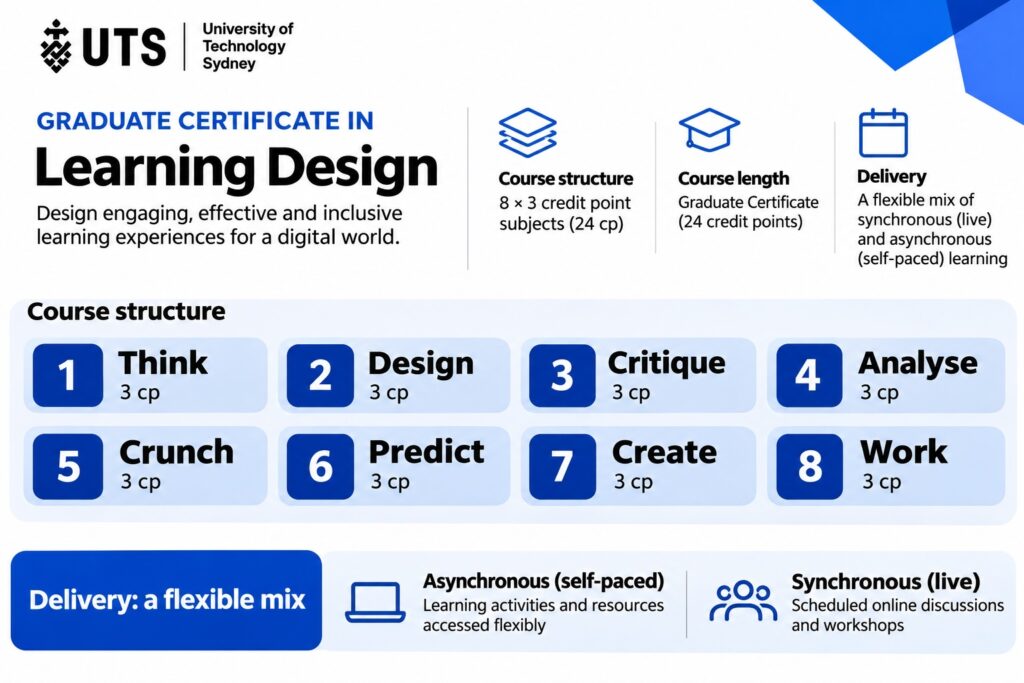
The design was also informed by Universal Design for Learning (UDL), particularly the principles of providing multiple means of engagement, representation, and action and expression.
In practice, this involved providing learning materials in different formats, incorporating interactive activities and designing assessments that enabled students to demonstrate their capabilities through the development of authentic professional artefacts.
However, my experience has reinforced the distinction between providing multiple formats and achieving genuine inclusion. While varied learning materials can reduce some barriers, they may introduce others. For example, visually complex interactive resources may support engagement for some learners while creating difficulties for others, particularly when accessibility has not been adequately considered.
This has encouraged me to approach inclusion as an ongoing process of design, testing, feedback and refinement rather than as a fixed set of technical requirements.
My work in this area also includes leading the development of an open educational resource titled Designing Learning Experiences for Inclusivity and Diversity, funded through an OER grant.
The resource was designed to support educators and learning designers in understanding and applying inclusive design principles. It addressed practical considerations such as accessible multimedia, alternative formats, screen-reader compatibility and approaches to inclusive assessment.
Developing this resource required translating principles of inclusion into guidance that educators could use in their own professional contexts. This was an important learning experience because it required consideration not only of the accessibility of the resource itself, but also of how effectively it could communicate complex design principles to practitioners with different levels of expertise.
The resource was made openly available, supporting its reuse beyond the original institutional context. My original portfolio reported more than 1,100 downloads, although download numbers alone cannot demonstrate that the resource has changed professional practice or improved learner experiences.
Reflecting on this work, I recognise that one of the challenges of promoting inclusive learning design is translating broad principles into practical decisions within environments shaped by limited time, resources, technical constraints and competing institutional priorities.
I also recognise that a commitment to inclusive design requires humility. The experiences of learners with disabilities and other access needs cannot be fully anticipated through general design principles alone. Consultation, feedback and attention to individual circumstances remain essential.
My professional learning in this area has therefore involved developing a more critical understanding of the relationship between accessibility, flexibility, learner agency and educational quality.
Looking forward, I intend to build on this work through further research and the development of resources addressing inclusive assessment, cultural responsiveness and the needs of learners with diverse circumstances and capabilities.
I also intend to strengthen the evaluation of my own inclusive learning design activities by examining not only the accessibility and reach of resources, but also how they are used and what difference they make to educational practice.